
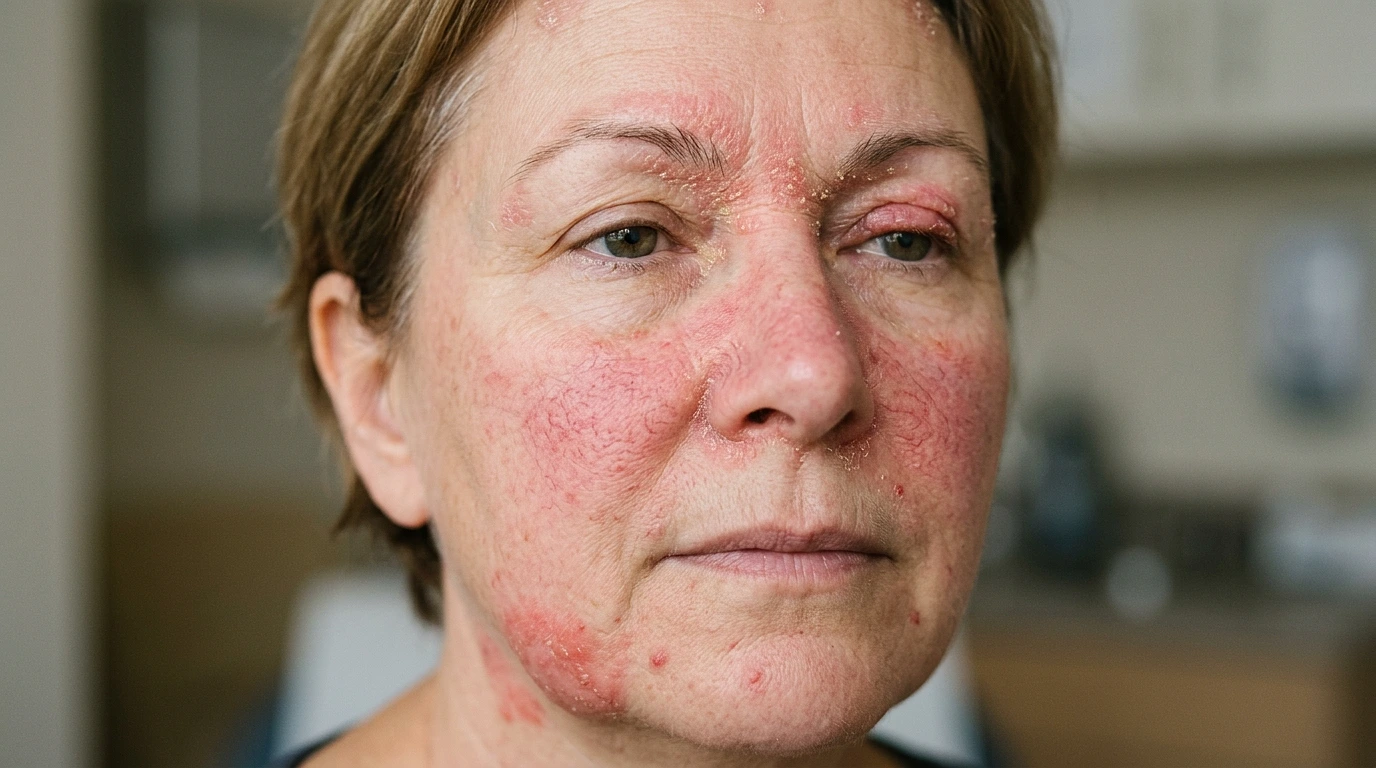
Because you’re probably tired and skimming, when seb derm, rosacea, and contact allergies all land on your face together, the reason nothing seems to work is that they aren’t one problem. They’re three, each with its own cause, and the stuff that helps one can light another one up. There’s no magic cream. What actually works is a layered approach, an antifungal for the seb derm, something anti-inflammatory for the rosacea, dodging your specific allergens, and keeping a steroid on standby for the bad days.
Most skincare advice is written like you’ve got one thing going on. Find a cleanser, find a moisturizer, put on the cream, done. That falls apart fast when your face is juggling three conditions, because they don’t agree on anything. The antifungal that quiets the flaking can become the allergen. The moisturizer that takes the sting out of the rosacea might have a fragrance your skin has flat-out declared war on.
So you end up running every product through an ingredient checker before it touches your face, washing with baby shampoo because it’s the one thing that hasn’t turned on you, and rationing a steroid for the nights it hurts too much to ignore. None of this is rare, and you’re not imagining it. Seb derm and rosacea show up together so often that derms basically expect the combo, and once a contact allergy joins the party, your whole routine becomes a negotiation.
Why They All Crowd Onto The Same Face
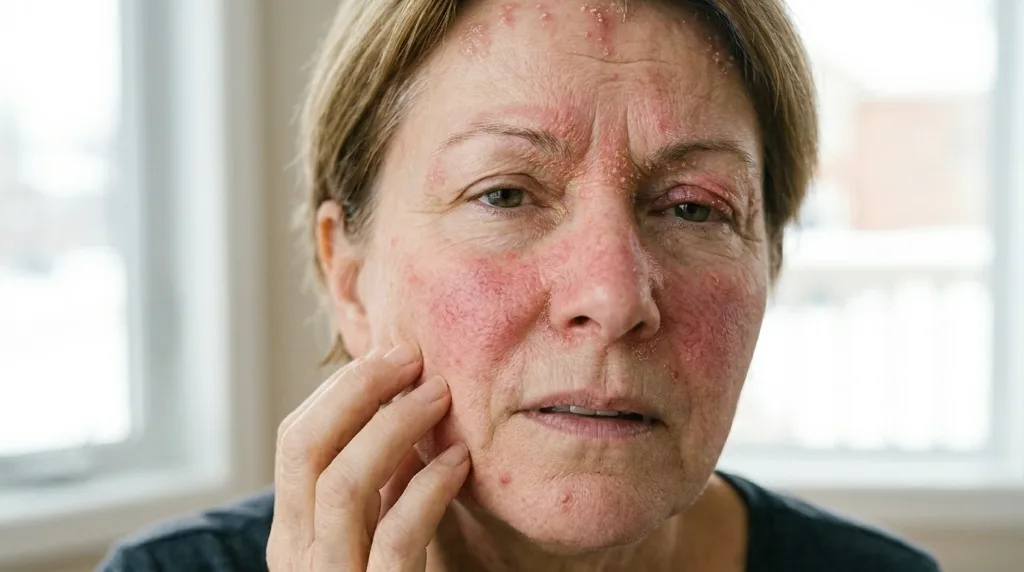
It starts with location. Each one has a favorite stretch of skin, and those stretches overlap big time.
- Seb derm goes where your skin’s oiliest: the scalp, eyebrows, the folds beside your nose, the space between your brows. That greasy little flake in the nose crease is its calling card.
- Rosacea sets up shop in pretty much the same zone, throwing redness across your cheeks, nose, chin, and forehead, usually with flushing that comes and goes and a stinging feeling when you put anything on.
- Since they’re camped on the same ground, a lot of people get diagnosed with both, and clearing up one can suddenly reveal the other hiding underneath.
The numbers explain why this combo is so common.
- Seb derm hits about 3% of adults in the serious, clinically significant sense, more in certain groups.
- Rosacea’s a notch higher, around 5.46% of adults worldwide, and it’s nearly 50% more common in women than men.
- Two conditions that are both common and both want the same patch of skin? Plenty of people draw both.
Then there’s the allergy piece. Allergic contact dermatitis is everywhere, and the face takes a lot of the hits, especially for women. Fragrances and preservatives in cosmetics are behind a big chunk of it. And once seb derm and rosacea have already roughed up your skin barrier, it gets touchy, reacting to stuff most people slap on without a thought. That’s the whole reason the product checker goes from annoying habit to genuine necessity.
What’s Actually Causing Each One
They look alike from across the room, but under the hood they’re running totally different machinery, which is exactly why one product can’t fix the lot.
- Seb derm is linked to a yeast called Malassezia that lives on everybody’s skin. It’s a normal tenant, found on most healthy adults, but in seb derm it seems to set off an overblown inflammatory reaction. It feeds on your skin’s oil and kicks out free fatty acids as it goes, and that leftover is thought to trigger inflammation in people whose skin doesn’t like it.
- Here’s the weird part: studies have found the Malassezia count doesn’t necessarily go down even when you treat it with antifungals. That hints the real issue is how your immune system reacts to the yeast, not just how much yeast is sitting there.
- Rosacea runs on something else entirely, a mix of an overactive innate immune response and blood vessels that don’t behave. That’s why flushing, lasting redness, and those little visible vessels are the giveaways. Heat, stress, certain foods, they trip it fast, because your nerves and your blood vessels are both in on it.
- Contact dermatitis is your immune system overreacting to one specific thing. You diagnose it with patch testing, because guessing almost never pans out, and the usual suspects are predictable: nickel, fragrance mixes, and preservatives like the isothiazolinones come up over and over.
Three engines, three different fuels. That’s the whole reason the one-and-done routine never holds up.
Why You Flare All Year, No Matter The Weather
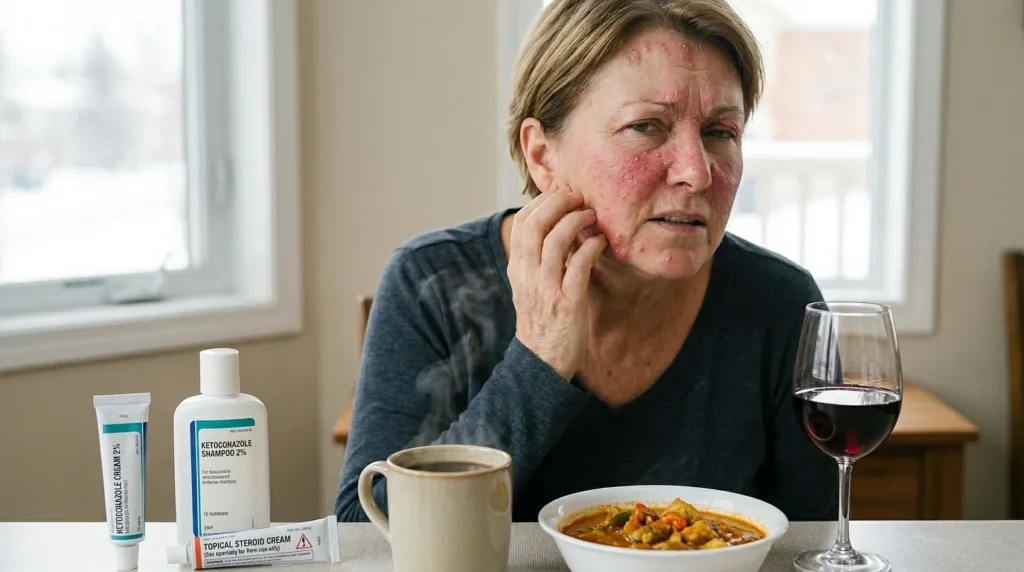
One of the more maddening things about this combo is that it doesn’t seem to care what season it is. And honestly, that lines up with the biology.
- Seb derm gets worse with humidity swings, seasonal changes, scratching or other irritation, and stress. Cold, dry air tends to be especially rough on it.
- Rosacea’s got its own laundry list: stress, hot drinks, alcohol, spicy food, exercise, and weather that’s too hot or too cold.
- The triggers overlap, especially stress and temperature, so one bad day can set both off at the same time.
But once a contact allergy is in the picture, the trigger might have nothing to do with weather. It could be something you’re putting on, or something rubbing off onto your skin. That matters most when the irritation pops up somewhere unusual, like your neck or jawline.
- Seb derm on the neck is less typical than seb derm in the nose folds, so if it’s creeping down there, say so to your derm specifically.
- That spread can point to a contact allergen, a fragrance, a preservative, maybe a hair product running down your neck overnight, instead of seb derm on its own.
- Where it shows up is the clue, not just the fact that it itches.
Where Treatment Gets Genuinely Tricky
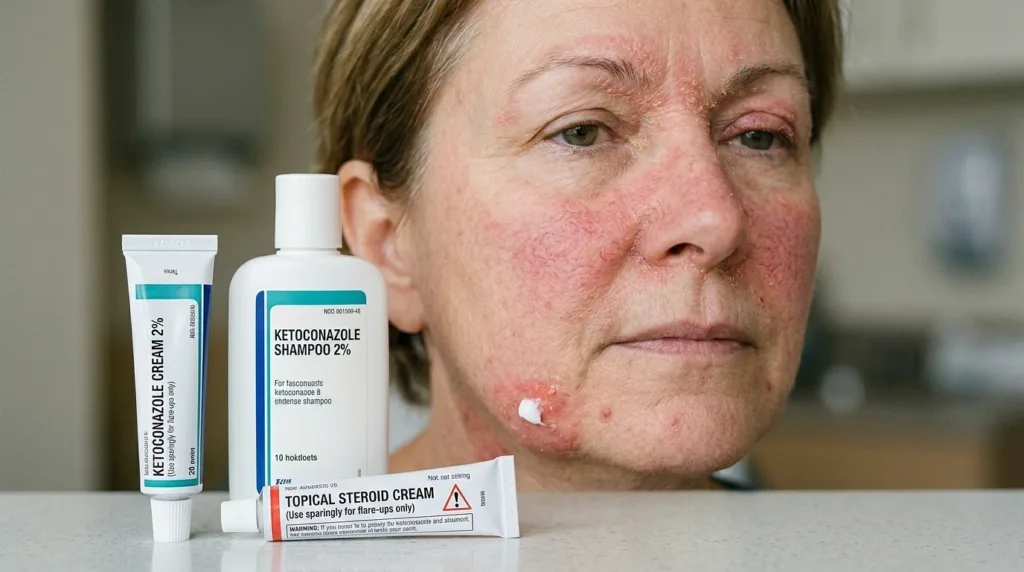
Here’s the catch-22. The same tools that calm one condition can stir up another.
- The go-to for seb derm is a topical antifungal, and ketoconazole is the workhorse, with reported effectiveness somewhere between 63 and 90%. Asking your derm about the cream to go with the shampoo is a totally reasonable move.
- The problem is that the thing meant to help can occasionally be the thing that hurts. A true allergy to ketoconazole itself is rare, but reactions to the other stuff in the cream, the base and the preservatives, are more common than a reaction to the drug. If you’ve already got known contact allergies, that’s your cue to add anything new slowly and keep an eye on it the first few days.
- Steroids come with their own warning label. A topical steroid can pull you out of a nasty flare, and saving it for the worst nights is smart. But leaning on a steroid long-term on your face can backfire, ramping up redness and making the rosacea worse over time. The “only when it gets really bad” rule is the safe one, not a sign you’re failing at this.
That’s why a real plan for overlapping conditions is layered instead of single-track: an antifungal for the seb derm, an anti-inflammatory or vessel-focused treatment for the rosacea, steady avoidance of your known allergens, and a steroid on reserve for actual flares. Each piece handles one engine. Not one of them handles all three.
What Actually Helps When You’re The One Living It
If you’ve patch-tested positive to certain allergens, avoidance is the strongest card you’ve got. It’s not exciting and it doesn’t come in a fancy jar, but with contact dermatitis, cutting out the culprit is the treatment. That ingredient checker that feels like a chore is quietly doing most of the work.
A few things worth writing down before your next derm visit.
- Bring up the neck specifically, because where it’s showing up might change what your doctor thinks is driving the whole thing.
- Ask if your current “safe” products have actually been checked against your real patch-test results, not just some generic safe list.
- If you’ve never had formal patch testing, or it’s been a few years, ask whether it’s time to redo it, since your allergens can change and new ones can crop up.
And the emotional side is real, too. This isn’t vanity.
- Rosacea’s got a documented hit on quality of life and self-esteem, with surveys showing most people who have it report feeling worse about themselves, and a lot of them avoid being face-to-face with people.
- Wanting to hide on a bad day is a normal, well-understood reaction to a condition you can see in the mirror, not a personal weakness.
- It’s worth saying out loud to your doctor, because the mental toll is part of the condition, not a side note to it.


About author

Add comment