
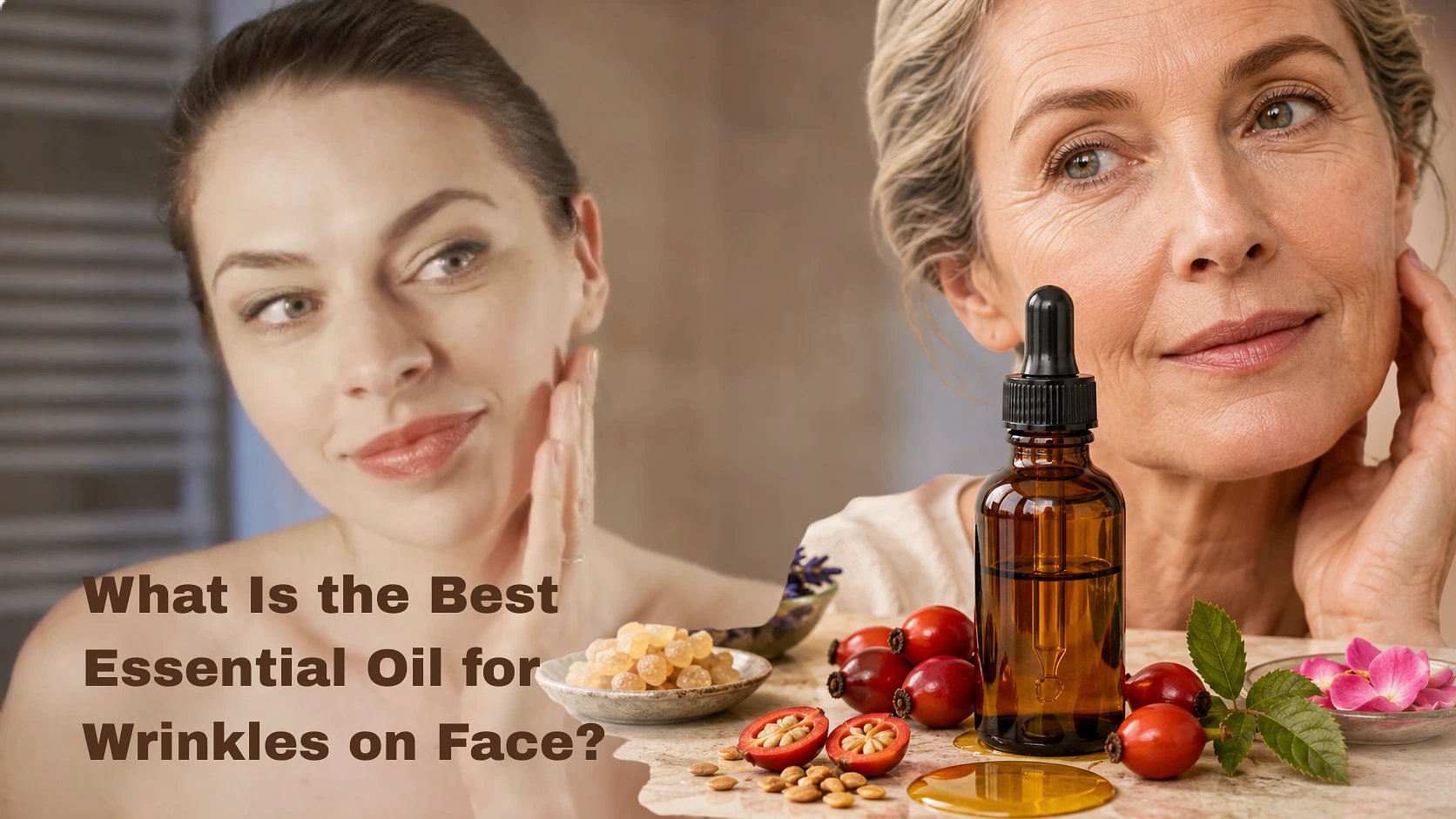
Rosehip seed oil though the honest answer comes with an asterisk: it isn’t actually an essential oil, and it’s the only thing in this category with clinical numbers behind it. Everything else people reach for (lavender, frankincense, geranium) is sold on scent and hope, not measured results on real faces.
1. Rosehip Seed Oil – The Only One With Real Wrinkle Data
The study everyone cites is Phetcharat, Wongsuphasawat and Winther (2015), in Clinical Interventions in Aging. It put 34 adults aged 35–65 with crow’s-feet through a randomized, double-blind trial against astaxanthin over eight weeks, measuring wrinkles, moisture and elasticity with a Visioscan, Corneometer and Cutometer. The rosehip group showed statistically significant improvements in crow’s-feet wrinkles, moisture and elasticity at eight weeks. To put a number on “improvement,” separate measurement put the crow’s-feet gain at around 8% over eight weeks, alongside a 15% rise in skin moisture and 12% in elasticity real, but a long way from dramatic.
The catch nobody mentions: participants swallowed the rosehip as an oral powder they didn’t apply it to their faces. The most-quoted “rosehip beats wrinkles” finding is a study about ingesting it. Topical evidence exists but is thinner a 2025 MDPI Cosmetics pilot of 27 people applying it daily for five weeks saw the biggest improvement in older participants but a pilot with no control group is a hint, not proof.
It works because of one real mechanism: it contains roughly 0.0357% tretinoin, a natural retinoid, low enough that it doesn’t cause photosensitivity. That’s a genuine anti-aging molecule at a tiny dose which is exactly why the effect is modest, not dramatic.
2. Frankincense – Good For Scars, Oversold For Wrinkles
Blogs love calling this the strongest anti-wrinkle oil. The medical sources don’t agree. There’s no evidence frankincense effectively treats wrinkles; its better-supported use is for stretch marks and scars. If your concern is scarring, it has a case. For lines on your face, it’s a fragrance with a reputation it didn’t earn.
3. Geranium – A Hypothesis Wearing A Lab Coat
No in-vivo study has tested rose geranium oil on wrinkles at all. What exists is an antioxidant effect from a 2014 study by Marin and colleagues, and the wrinkle benefit is only inferred from that never actually demonstrated. Plausible mechanism, zero wrinkle measurements.
4. Lavender – Scent Doing All The Work

Lavender is popular in cosmetics for its soothing smell, but there’s no evidence it treats wrinkles. It’s the clearest example of the whole problem with this question.
The Honest Summary, In One Line
A systematic review of 70 studies over the past decade found lavender and rosemary showed promising anti-inflammatory and anti-aging signs, but stressed that proper long-term trials are still missing. “Promising, more trials needed” is the real state of the field not “this oil erases wrinkles.”
Rosehip if you’re looking for the best-evidenced oil, but don’t expect miracles, which is about a 8% improvement, over 8 weeks. However, if you’re looking for the best wrinkle product not the best essential oil when any oil is touted as performing as well as a retinoid, the essential oils have been abandoned somewhere along the way. The Watch 4 Beauty guide to natural anti-aging oils goes through the same pros and cons: The most non-irritating oils have the weakest evidence, while the most potent often seem to be the oils you’re not willing to try.
Here is a safety note that is practical: patch-test for 24-hours on the inner forearm (e.g., if you’re using a true essential oil, dilute it in a carrier oil before exposing it near your face undiluted, as they are common offenders). This information is not medical advice if pregnant or if you have a skin care condition, ask a dermatologist first.
References
- Phetcharat L, Wongsuphasawat K, Winther K. “The effectiveness of a standardized rose hip powder, containing seeds and shells of Rosa canina, on cell longevity, skin wrinkles, moisture, and elasticity.” Clinical Interventions in Aging, vol. 10, 2015, pp. 1849–1856.
- MDPI Cosmetics, 2025 topical rosehip oil pilot study (n=27).
- “Evaluating efficacy, safety, and innovation in skin care applications of essential oils: a systematic review.” NCBI/PMC, 2025.
- Marin P.D. et al. “Chemical composition, antifungal and antioxidant activity of Pelargonium graveolens essential oil.” Journal of Applied Pharmaceutical Science, 2014.

About author

Add comment