
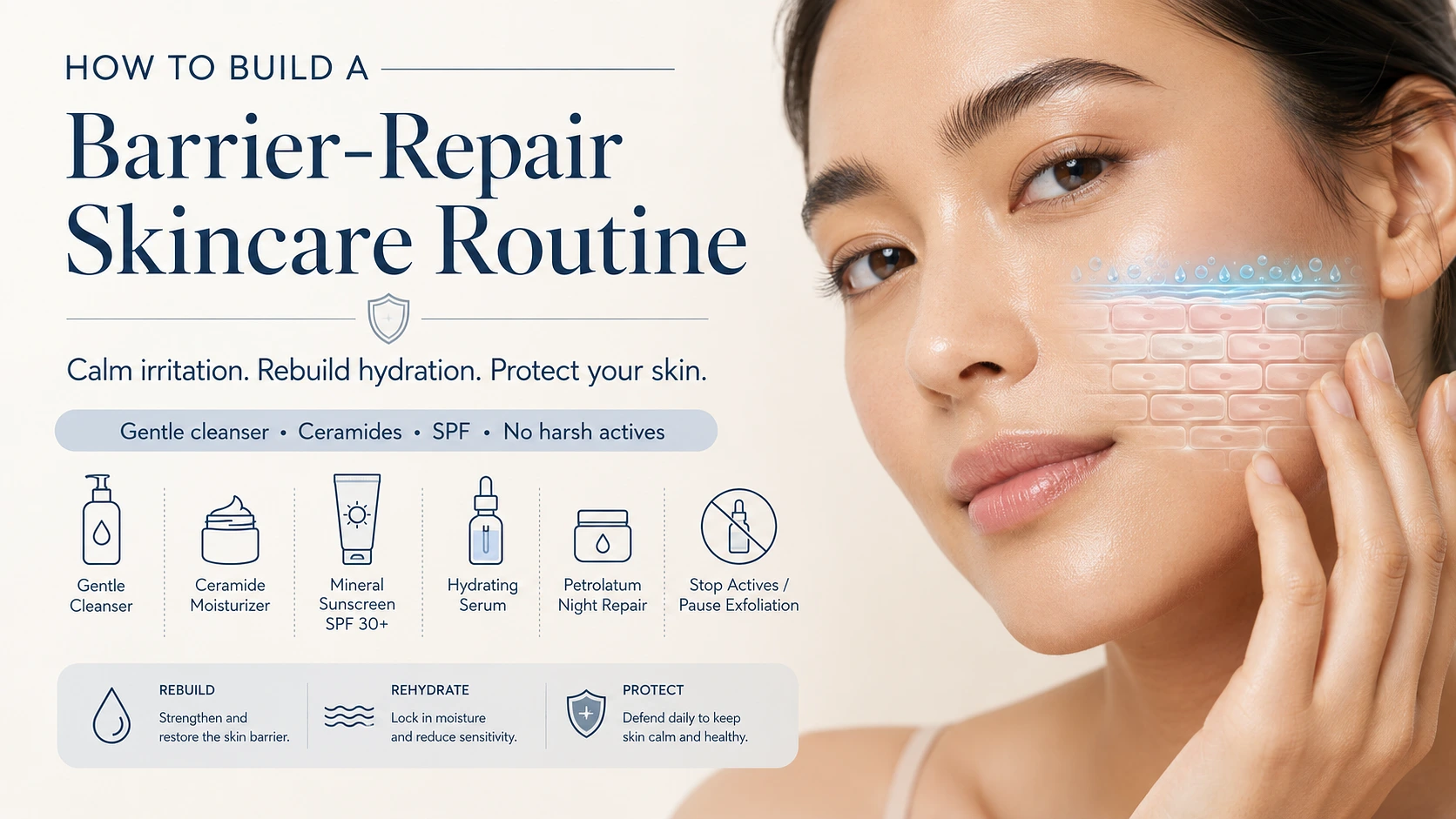
Quick Read:
- A damaged barrier usually heals on its own in two to four weeks if you stop irritating it.
- The fix is mostly subtraction, not addition. Cut the actives first, then add ceramides and a thicker moisturizer.
- Stinging on application is the clearest sign your barrier is actually compromised, not just dry.
- Petrolatum at night (slugging) works for most people but not the acne-prone.
- If your skin is oozing, cracking, or rashing, this article isn’t for you. See a dermatologist.
A Short Reality Check on “Barrier Damage”
The phrase gets thrown around a lot. Half the people using it have mild irritation from a new retinol that’ll calm down in three days. The other half have a genuinely disrupted stratum corneum that needs structured care.
Knowing which camp you’re in changes everything about what you should do next. Treating mild irritation like full barrier collapse means weeks of overcautious routine for no reason. Treating real barrier damage like a normal dry patch means it keeps getting worse while you layer more product on top.
What the Barrier Actually is, Without the Marketing
Your stratum corneum is the outermost layer of skin, about 0.02mm thick across most of your face. Thinner on the eyelids. Thicker on the soles of your feet. It’s the only thing between your bloodstream and the rest of the world.
The structure is often compared to a brick wall. Flattened dead skin cells (corneocytes) sit packed together as the bricks. Between them, a lipid matrix acts as the mortar. That mortar is made of three main fats:
- Ceramides, around half of the total.
- Cholesterol, roughly a quarter.
- Free fatty acids, the rest.
The proportions matter more than the ingredients in isolation. You can pile ceramide serum on skin all day, but if the ratio is off, the barrier doesn’t reassemble properly. This is why single-ingredient “ceramide repair” products often underperform compared to formulas that include all three lipids.
How to Actually Tell if Yours is Damaged
Skip the quizzes. Use these markers:
- A product that worked fine last month suddenly stings. Especially anything with niacinamide, vitamin C, or AHAs.
- Within five minutes of cleansing, your skin feels tight even after you’ve moisturized.
- The flaking is patchy and shows up where it never used to.
- Foundation refuses to sit. It either pills, sinks into texture, or sits on top like it can’t decide which.
- Sleeping on your side leaves a red imprint that takes longer than usual to fade.
If your face is rashing, weeping, or cracking, stop reading and book a dermatologist. That’s a different problem.
The Mistake Almost Everyone Makes First
When skin starts misbehaving, the instinct is to add things. A new moisturizer. A barrier serum someone recommended on Reddit. Maybe a sheet mask.
This usually makes things worse, because the cause was almost always something you were already doing. More layers means more potential irritants on already compromised skin.
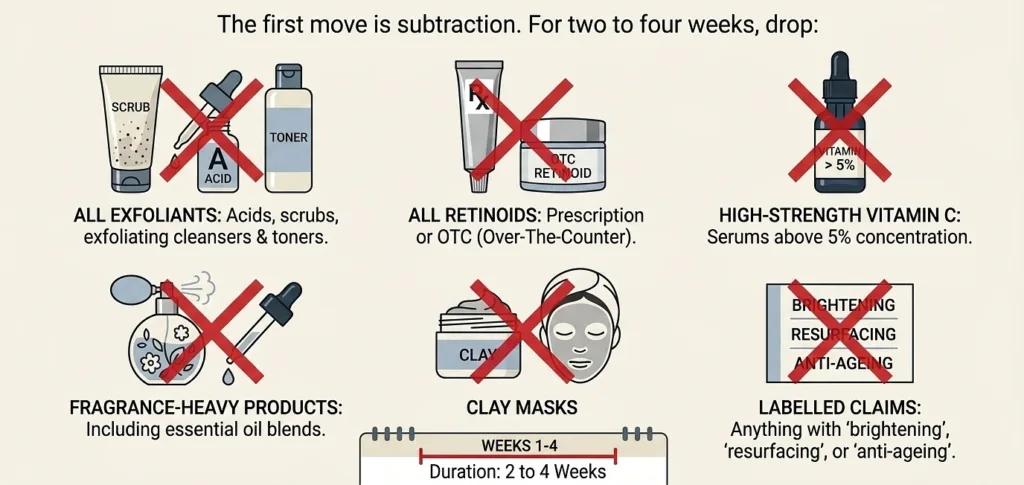
The first move is subtraction. For two to four weeks, drop:
- Every form of exfoliation. Acids, scrubs, exfoliating cleansers, exfoliating toners, exfoliating anything.
- All retinoids, prescription or OTC.
- Vitamin C serums above 5%.
- Fragrance-heavy products, including essential oil blends.
- Clay masks.
- Anything labelled brightening, resurfacing, or anti-ageing.
Yes, including the things you spent money on. They’ll be there in three weeks when you’re healed.
Cleansing During Repair Mode
The cleanser does more damage during this phase than any other product, because it’s the one thing that strips lipids off rather than putting them back. Most people underestimate this.
What you want:
- A pH in the range of 4.5 to 5.5. This matches the skin’s natural acid mantle.
- No sulfates. Sodium lauryl sulfate and sodium laureth sulfate are the main offenders. Look at the back of the bottle.
- Minimal fragrance.
- A cream, milk, or balm texture. Foaming cleansers can work if formulated gently, but most aren’t.
Wash once at night. In the morning, splash lukewarm water and move on. Patting dry with a clean towel beats rubbing every single time.
What Actually Rebuilds the Barrier
Three categories of ingredients have real evidence behind them. Most of the rest is marketing dressed up in scientific language.
- Ceramides: These are the lipids your barrier is missing. Topical application works because ceramides integrate into the skin’s existing structure rather than sitting on top. The catch: ratio matters. Products that pair ceramides with cholesterol and fatty acids tend to outperform ceramide-only formulas.
- Niacinamide: A 2-5% concentration boosts the skin’s own ceramide production while reducing water loss. It’s mild enough for most compromised barriers, though if your skin is in full meltdown, even niacinamide can sting and you should wait a few days.
- Panthenol and centella asiatica: These calm inflammation rather than rebuild structure. Useful for the “stinging when I touch my face” stage of damage.
Hyaluronic acid and glycerin pull water into the skin. They feel good and they help, but they don’t repair anything. Think of them as support staff, not the main intervention.
What Two Weeks Looks Like
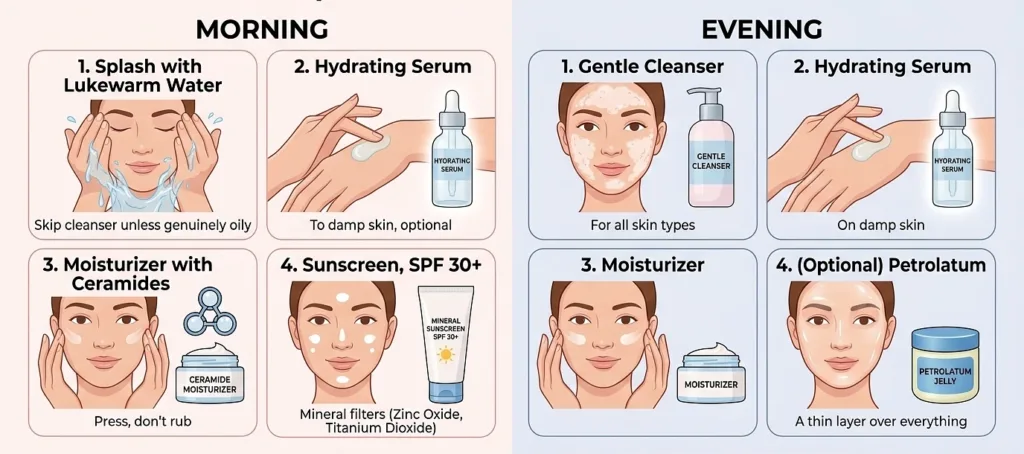
Morning routine:
- Splash with lukewarm water. Skip cleanser unless your skin is genuinely oily by morning.
- Apply a hydrating serum to damp skin, optional but useful in dry climates.
- Moisturizer with ceramides. Press, don’t rub.
- Sunscreen, SPF 30 minimum. Mineral filters (zinc oxide, titanium dioxide) are the least likely to sting.
Evening routine:
- Gentle cleanser.
- Hydrating serum on damp skin.
- Moisturizer.
- Optional: a thin layer of petrolatum over everything (more on this below).
That’s it. No toner, no essence, no eye cream, no spot treatment. The shorter your routine, the faster you heal.
On Slugging
The trend has actual research behind it. The Ghadially, Halkier-Sorensen and Elias paper from 1992 found something counterintuitive about petrolatum: it doesn’t just block water loss like a plastic wrap. It penetrates into the intercellular spaces of the stratum corneum and lets the barrier recover beneath it, which is why people wake up with skin that looks better, not just shinier.
Three caveats:
- Acne prone skin should not slug. It traps bacteria along with everything else.
- Use a thin layer, not a thick smear. A pea-sized amount across the whole face.
- Wash your pillowcase more often if you do this regularly. Petrolatum transfers.
When You Can Stop and Start Adding Things Back
You’re not healed when your skin stops hurting. You’re healed when:
- Stinging hasn’t happened in a week, even when you tested a small amount of a previous active.
- Flaking is gone.
- Skin doesn’t feel tight at any point during the day.
- Foundation goes on like it used to.
When you reintroduce actives, pick one. Use it twice in week one, three times in week two, and only daily after two weeks of no reaction. If you used to use four actives, you’ll need at least eight weeks to get them all back in your routine. This feels slow. It’s not slow. It’s the actual timeline of how skin tolerates active ingredients.
A common pattern: people repair the barrier, feel triumphant, immediately go back to the routine that broke it, and end up back here in six weeks. The barrier you rebuilt is exactly as vulnerable as the one you broke. Treat it accordingly.
The Non Skincare Factors That Matter More than People Admit
Sleep changes barrier function in measurable ways. A study by Oyetakin-White and colleagues in 2015 looked at 60 women split by sleep quality and found that good sleepers had roughly 30% greater barrier recovery after tape stripping than poor sleepers. They also had lower baseline transepidermal water loss. No serum on the market improves recovery by 30%.
Stress affects this too, mostly through cortisol’s effect on lipid synthesis. The lipid mortar takes longer to assemble when cortisol is elevated.
Water intake is overhyped. Drinking eight glasses a day won’t fix a compromised barrier, because the stratum corneum gets its hydration from the layers below it and from humectants applied topically, not from your kidneys. Drink water because you should, but don’t expect it to do skincare work.
References
- Meckfessel, M. H., & Brandt, S. (2014). The structure, function, and importance of ceramides in skin and their use as therapeutic agents in skin-care products. Journal of the American Academy of Dermatology, 71(1), 177–184 – https://www.jaad.org/article/S0190-9622(14)01022-6/abstract
- Ghadially, R., Halkier-Sorensen, L., & Elias, P. M. (1992). Effects of petrolatum on stratum corneum structure and function. Journal of the American Academy of Dermatology, 26(3), 387–396 – https://www.jaad.org/article/0190-9622(92)70060-S/abstract
- Oyetakin-White, P., Suggs, A., Koo, B., Matsui, M. S., Yarosh, D., Cooper, K. D., & Baron, E. D. (2015). Does poor sleep quality affect skin ageing? Clinical and Experimental Dermatology, 40(1), 17–22 – https://onlinelibrary.wiley.com/doi/10.1111/ced.12455


About author

Add comment