
Polydeoxyribonucleotide, or PDRN for short, is a low-molecular-weight DNA fragment that is extracted from trout or salmon sperm and used in skincare products to stimulate the skin’s natural collagen-building and healing processes. That’s the condensed form. The lengthier one includes fibroblasts, adenosine receptors, and an odd route from treating diabetic ulcers to getting a high-end Korean facial.
Quick points before the detail:
- PDRN comes from chum salmon or rainbow trout sperm DNA.
- It has been used in regenerative medicine since the 1990s.
- The cosmetic use is newer and rides on the same wound-healing mechanism.
- Three forms: serums, injectables, microneedling solutions.
- Main payoff: collagen, hydration, scar repair, calmer skin, brighter tone.
- Not a filler. Results show up over weeks, not minutes.
What Is PDRN Skincare
PDRN is not a single molecule. It is a mix of short DNA chains, molecular weights between 50 and 1,500 kDa, extracted and purified from fish sperm cells almost always chum salmon (Oncorhynchus keta) or rainbow trout (Oncorhynchus mykiss) [Squadrito et al., 2017]. The purification step matters. It strips out proteins and peptides that could cause an allergic or immune reaction, which is what makes PDRN tolerable across decades of Clinical Use of PDRN.
The path into skincare was sideways. PDRN was developed for wound healing diabetic foot ulcers, burns, post-surgical recovery. Clinicians noticed it didn’t just patch wounds. It left the surrounding skin looking better. That observation pulled it into aesthetic dermatology [Akaberi et al., 2025].
Right now the ingredient is most established in South Korea and Italy, where injectable PDRN is a clinic staple. The rest of the world, the United States especially, is still working through regulatory approval and is mostly limited to topicals and microneedling.
Three delivery routes you will actually run into:
- Topical serums – work on the surface and upper layers, gentlest version.
- Microneedling with PDRN solution – often marketed as the “salmon sperm facial”.
- Intradermal injection or mesotherapy – deepest reach, strongest results, tightest regulation.
Key Benefits of PDRN Skincare
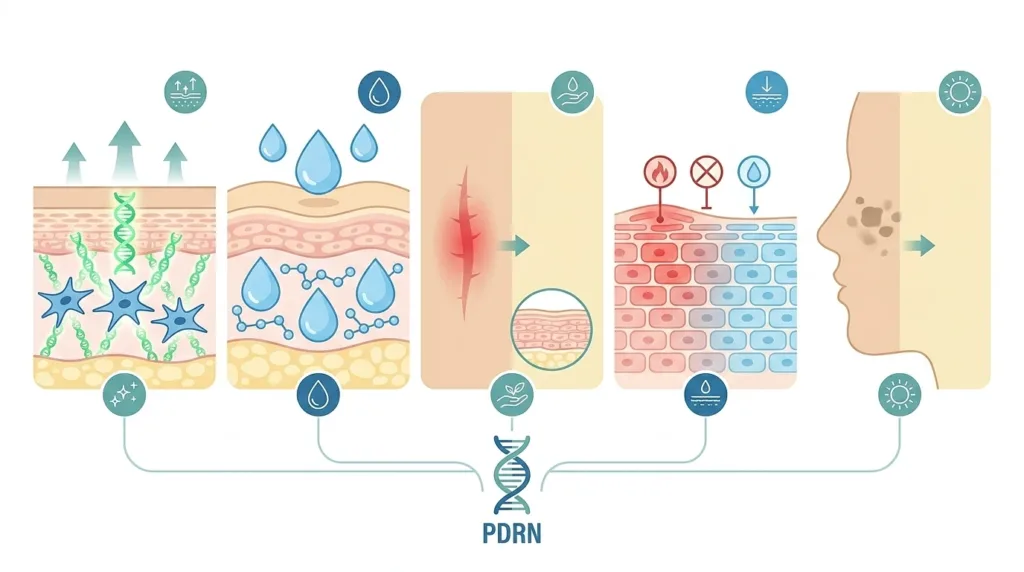
The thread tying these together is regeneration. PDRN does not sit on the skin like a moisturiser. It signals the skin to rebuild itself.
Collagen synthesis. PDRN switches on fibroblasts the cells that produce collagen and elastin. Over a treatment course, skin firms up and bounces back more readily [Akaberi et al., 2025].
Hydration that holds. Rather than coating the surface, PDRN supports hyaluronic acid production inside the dermis. The hydration is built from within, which is why it tends to outlast a standard hydrating serum.
Scar and wound repair. This is the strongest evidence base PDRN has. Atrophic acne scars, surgical wounds, and burns have all been studied PDRN-treated skin heals faster and scars less deeply [Squadrito et al., 2017].
Calmer skin. PDRN blocks the NF-κB inflammatory pathway and lowers IL-6 and TNF-α both messengers behind redness and reactivity (ScienceDirect, 2022). Useful for post-procedure skin, rosacea-prone skin, or anyone whose face flares too easily.
Pigment control. Measurable anti-melanogenic activity. Sunspots, post-acne marks, uneven tone all of these respond, slowly.
Sun-damage repair: According to a 2025 review, PDRN decreased senescence markers including p16 and p53, which are both associated with cellular aging, and increased SIRT1 expression in UVB-damaged skin [MDPI Applied Sciences, 2025]. According to a 2025 review, PDRN decreased senescence markers including p16 and p53, which are both connected to cellular aging, and increased SIRT1 expression in UVB-damaged skin [MDPI Applied Sciences, 2025].
What it will not do is fill a deep wrinkle or replace a filler. PDRN is a regenerator, not a volumiser. Anyone expecting needle-in, needle-out results from one session usually ends up disappointed.
How PDRN Skincare Works
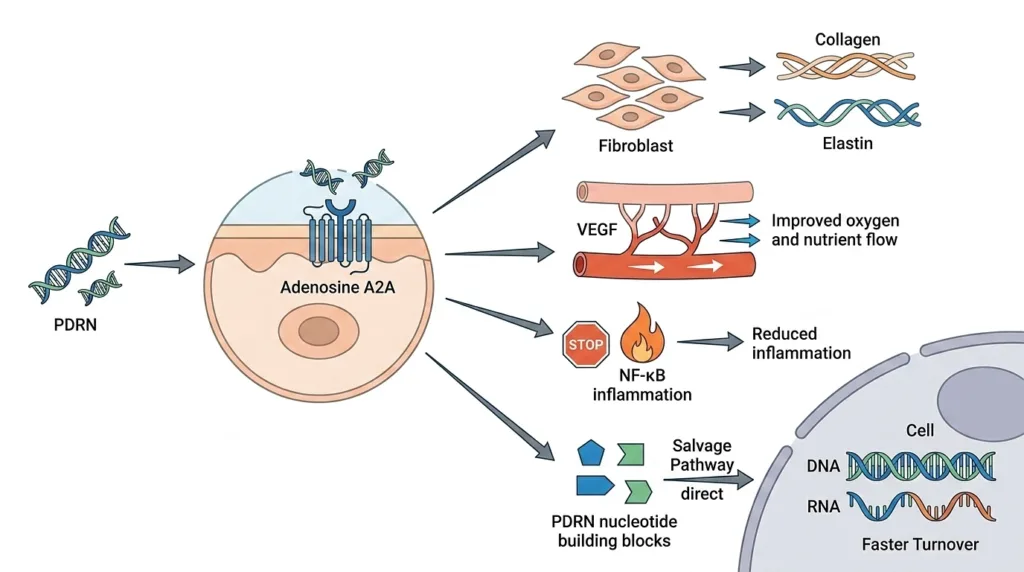
The mechanism is mostly about one receptor: adenosine A2A.
When PDRN binds to that receptor on the surface of skin cells, it causes fibroblasts to proliferate, releases VEGF, which creates new capillaries, and inhibits the NF-κB inflammatory cascade [Squadrito et al., 2017]. In essence, the skin acts as though it is healing a wound even when there is no visible damage. Activation inhibits the NF-κB inflammatory cascade, stimulates fibroblast proliferation, and releases VEGF, which creates new capillaries [Squadrito et al., 2017]. Even when nothing is obviously damaged, the skin effectively acts as if it is healing a wound.
PDRN provides ready-cut nucleotide building blocks so the cell doesn’t have to synthesize them from scratch, which reduces metabolic expenditure and speeds up turnover. This second pathway works parallel to the salvage pathway. Skin cells undergoing repair need raw material to construct new DNA and RNA (ScienceDirect, 2022). In order to create new DNA and RNA, skin cells undergoing repair need raw materials. The cell does not need to synthesize nucleotide building blocks since PDRN provides pre-cut nucleotide building blocks (ScienceDirect, 2022). Faster turnover and lower metabolic expense.
Three things change as a result:
- Fibroblast activity rises – more collagen, more elastin.
- Microcirculation improves – better oxygen and nutrient flow into the dermis.
- Inflammation drops – skin reacts less, recovers faster.
Delivery decides how deep this happens. Topicals work on the upper layers and depend heavily on formulation. Microneedling drives the solution past the stratum corneum into the upper dermis. Injection the gold-standard route for clinical results places PDRN exactly where fibroblasts live [Akaberi et al., 2025].
The side-effect profile is small. Most published trials report transient redness or mild swelling at the application or injection site and nothing significant beyond that [MDPI Applied Sciences, 2025].
Long-term cosmetic data is still building. The mechanism, on the other hand, is no longer in doubt and the medical record stretches back three decades. That is a combination skincare ingredients rarely get.
References
- Squadrito, F. et al. (2017). Pharmacological Activity and Clinical Use of PDRN. Frontiers in Pharmacology. PMC5405115.
- Akaberi, S.M., Sharma, K., Ahmadi-Ashtiani, H.R., Hedayati, M. (2025). Polydeoxyribonucleotide in Skincare and Cosmetics: Mechanisms, Therapeutic Applications, and Advancements Beyond Wound Healing and Anti-aging. Journal of Skin and Stem Cell, 12(1): e159728.
- Polydeoxyribonucleotide: A promising skin anti-aging agent (2022). ScienceDirect / Chinese Journal of Plastic and Reconstructive Surgery.
- Polydeoxyribonucleotides as Emerging Therapeutics for Skin Diseases (2025). MDPI Applied Sciences, 15(19): 10437.


About author

Add comment